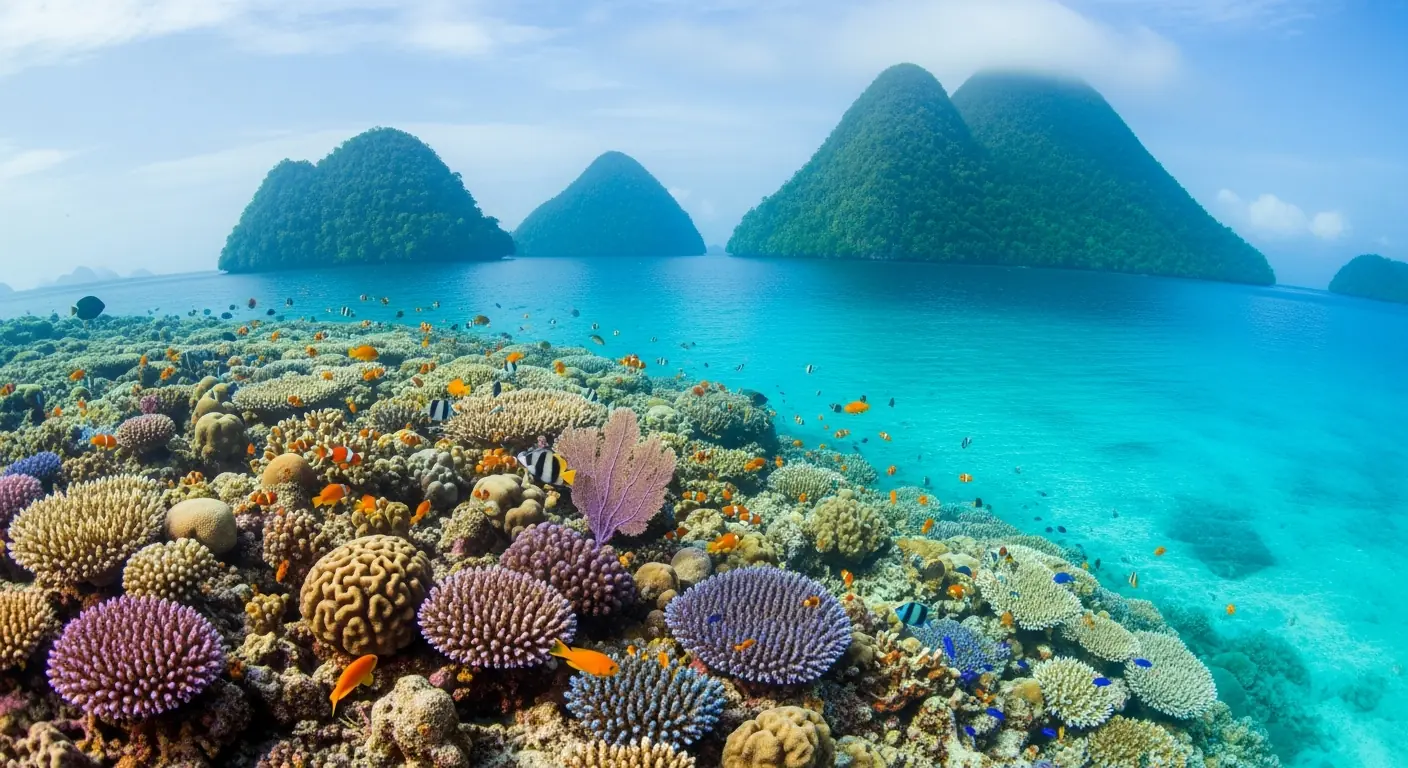
The air in Halmahera carries the scent of cloves and nutmeg, a constant reminder of its history. Distant calls of unseen birds echo from the dense jungle canopy. This island, the largest in the Maluku Islands, offers a landscape where volcanic peaks meet coral reefs, and where the past resonates through scattered wartime relics and ancient trade routes. The journey here is an immersion into a natural world still largely untamed, a destination for those who seek exploration beyond the well-trodden paths.
Halmahera’s Geography and the North Maluku Archipelago
Halmahera dominates the province of North Maluku, an expanse of land and water in eastern Indonesia. The island itself stretches across approximately 18,000 square kilometres, making it the largest landmass within the Maluku Islands. This vastness contributes to its diverse ecosystems, from coastal mangroves to highland forests. North Maluku consists of hundreds of islands, including Halmahera, Ternate, Tidore, and Morotai, each playing a role in the region’s historical and ecological narrative. Ternate, often the initial point of entry, is a volcanic island situated just west of Halmahera. The main access route to Halmahera for travellers is typically via flight to Ternate, followed by a boat crossing to various points on Halmahera. These inter-island connections are fundamental to understanding travel within this part of Indonesia. The geography here is defined by deep bays and narrow peninsulas, characteristic of an island shaped by volcanic activity over millennia. The Halmahera rainforests form a distinct ecoregion within the North Maluku Province, a sign of the island’s unique biodiversity. This ecoregion is a critical habitat for numerous endemic species.
Diving the Waters of North Maluku: Morotai and Weda Bay
The waters surrounding Halmahera and its neighbouring islands offer diverse dive experiences, appealing to both recreational and technical divers. Morotai, an island located northeast of Halmahera, is particularly renowned for its World War II wreck diving. The Battle of Morotai in 1944 left behind a scattering of ships, aircraft, and other artifacts beneath the waves, creating a unique underwater museum. Divers can explore Japanese cargo ships, American fighter planes, and various military equipment, often in relatively shallow depths, with visibility typically ranging from 15 to 30 meters. Beyond Morotai, Weda Bay, situated on the eastern coast of Halmahera, is gaining recognition as a prime location for pristine coral reefs and macro marine life. This area is part of the Coral Triangle, a global epicentre of marine biodiversity. Specific dive sites in Weda Bay feature healthy hard and soft coral gardens, home to pygmy seahorses, various nudibranchs, and schooling reef fish. The water temperature generally remains between 27°C and 29°C year-round, making for comfortable diving conditions. These sites cater to different skill levels, from beginners exploring vibrant shallow reefs to experienced divers seeking pelagic encounters in deeper currents.
Spice Island Heritage and Cultural Encounters
Halmahera and its surrounding islands are steeped in the history of the Spice Trade, a period that profoundly shaped global commerce and local cultures. For centuries, cloves and nutmeg, native to the Moluccas, were highly prized commodities. While the epicentre of this trade was often focused on smaller islands like Ternate and Tidore, Halmahera played a significant role in the broader network, providing resources and trade routes. Today, remnants of this heritage are visible in the traditional villages and cultural practices found across the island. Tobelo, a town in North Halmahera, serves as a cultural hub, particularly known for its vibrant markets where local produce, including spices, is still traded. Galela, another significant area, offers insights into local customs and traditional fishing practices. Annual festivals, often tied to harvest seasons or historical events, provide opportunities to witness traditional dances and music. The local languages, such as Tobelo and Galela, are still widely spoken, reflecting the diverse ethnic groups that inhabit Halmahera. These communities maintain a strong connection to their ancestral lands and traditions, offering a glimpse into the enduring legacy of the Spice Islands.
Exploring Halmahera’s Rainforests and Endemic Wildlife
The Halmahera rainforests form a distinct ecoregion within the North Maluku Province, presenting a critical habitat for a variety of unique flora and fauna. This biodiverse ecosystem is characterized by dense tropical rainforests, often extending from coastal areas to mountainous interiors. The island’s geological isolation has led to the evolution of several endemic species, making it a significant site for biodiversity conservation. Birdwatching is a primary draw for many visitors, with specific interest in species like Wallace’s standardwing (Semioptera wallacii), a bird of paradise famous for its elaborate courtship display. Other endemic birds include the Halmahera cuckooshrike and the Halmahera flowerpecker. Tracking these species often requires guided excursions into the less accessible forest areas, particularly around Weda Bay and the Aketajawe-Lolobata National Park. Beyond avian life, the rainforests are home to various reptiles, amphibians, and insects, many of which are still being catalogued. The rugged terrain and dense vegetation mean that exploration often involves trekking through challenging conditions, but the rewards include encounters with rare wildlife and unspoiled natural landscapes. Conservation efforts are ongoing to protect these invaluable ecosystems from deforestation and other threats.
Navigating Halmahera: Travel and Logistics
Travelling to and around Halmahera requires careful planning, reflecting its status as a less developed tourist destination compared to other parts of Indonesia. The main access route for travellers is typically via flight to Ternate, followed by a boat crossing to Halmahera. Ternate’s Sultan Babullah Airport (TTE) receives flights from major Indonesian cities like Jakarta and Makassar. From Ternate, public speedboats and ferries depart regularly for various ports on Halmahera, including Sofifi (the provincial capital on Halmahera’s west coast), Tobelo, and Sidangoli. The crossing duration varies, with speedboats to Sofifi taking approximately 45 minutes to 1 hour, while journeys to more distant points like Tobelo can take several hours. Once on Halmahera, inter-island transport in Maluku relies on a combination of local buses, shared taxis, and chartered boats for reaching specific dive sites or remote villages. Roads can be unpaved or poorly maintained in certain areas, particularly away from main population centres. Tour itineraries commonly combine Ternate, Tidore, and North Halmahera in trips of about 1 to 2 weeks in North Maluku, allowing for a comprehensive exploration of the region’s diverse offerings. Accommodation options range from basic guesthouses in towns like Tobelo to more specialized dive resorts in areas like Weda Bay.
Learn more about Halmahera on Wikipedia.
Discover more about North Maluku.
Explore the Maluku Islands.
Halmahera Pearl serves as an independent editorial guide to this remarkable island, offering insights for adventure travellers and divers. For detailed itineraries and further exploration of Halmahera, navigate back to the Halmahera Pearl homepage.